
Logistics Leader of the Year / 2026 / Cameroon
Cyrus Ngo’o stands among the most influential public sector leaders shaping the maritime and logistics landscape of Central Africa. As Director General of the Port Authority of Douala, he oversees the management and strategic development of one of the region’s most important gateways for international trade. Since his appointment in August 2016, Ngo’o has led an ambitious program aimed at modernizing the port, improving efficiency, and positioning Douala as a competitive logistics hub serving not only Cameroon but also several landlocked countries in Central Africa.
Born on 28 October 1966 in Garoua, Cameroon, Cyrus Ngo’o traces his family origins to Messamena in the country’s East Region. His academic journey reflects the path of a disciplined public administrator. After studying at the University of Yaoundé I, he graduated from the National School of Administration and Magistracy (ENAM), Cameroon’s premier institution for training senior civil servants. He later strengthened his managerial and strategic skills with an MBA from the Université du Québec à Montréal in Canada.
Ngo’o’s professional career developed largely within the Cameroonian public administration. Before taking the helm at the Port of Douala, he served as an adviser to the Prime Minister on the monitoring and implementation of public policies covering sectors such as infrastructure, energy, water, mining, and port development. In that role he gained extensive exposure to national infrastructure strategy and large-scale investment planning.
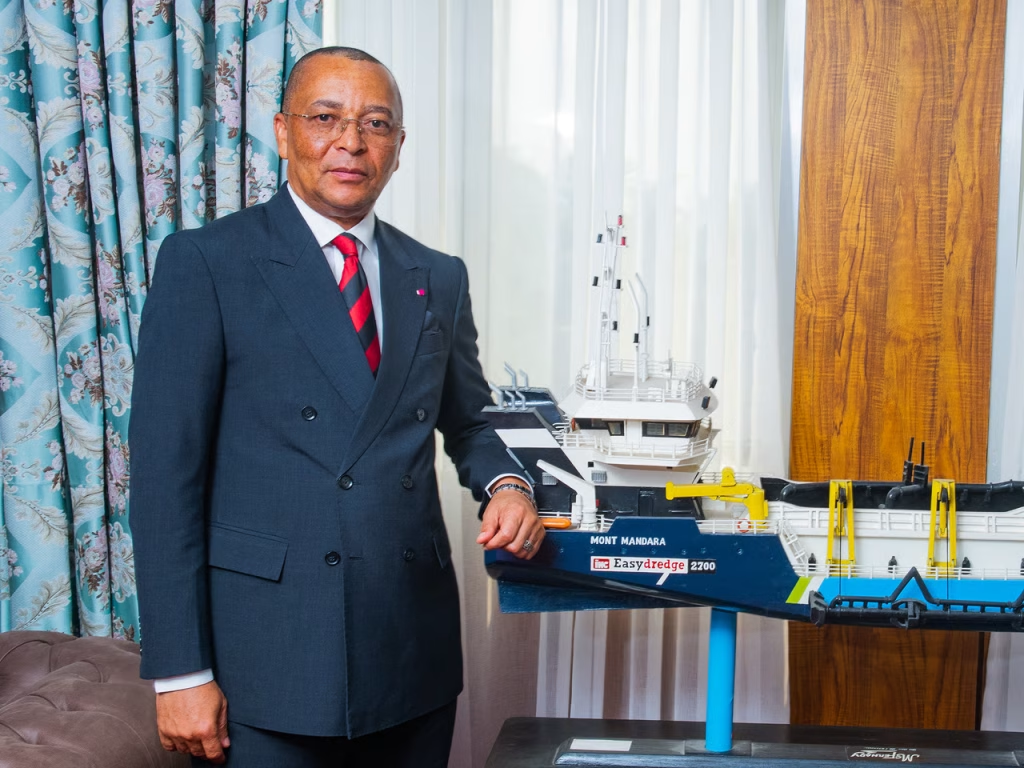
His experience also includes coordinating the Mbalam iron ore project and chairing the procurement commission for the container terminal at the Port of Kribi, another major maritime infrastructure project in Cameroon. These roles gave him first-hand experience in complex infrastructure development and public-private collaboration, skills that would later prove essential in his leadership of the Douala port.
When Ngo’o assumed leadership of the Port Authority of Douala in 2016, he inherited an institution under pressure from rising cargo volumes, aging infrastructure, and operational bottlenecks. The port, originally designed to handle around seven million tonnes of cargo annually, had begun processing significantly larger volumes, placing strain on its facilities and logistics systems.
His response was a broad reform and modernization agenda focused on infrastructure renewal, operational efficiency, and improved governance. The program included upgrading port infrastructure, simplifying tariff structures, digitalizing procedures related to vessel and cargo handling, and strengthening regulatory oversight of auxiliary port professions. These reforms were aimed at reducing vessel turnaround times, improving cargo handling efficiency, and restoring confidence among shipping lines and logistics operators.
Under his leadership, the port has also pursued strategic partnerships and major investment projects designed to expand the logistics ecosystem around Douala. One example is the development of new logistics and industrial zones along the Dibamba River, designed to create integrated industrial and multimodal logistics platforms that can support manufacturing, agro-processing, and regional trade. The project is expected to generate thousands of direct jobs and stimulate broader economic activity in Cameroon’s industrial sector.

Ngo’o has also championed initiatives to modernize port technology and security infrastructure. Partnerships with technology firms are enabling the deployment of digital systems, high-speed telecommunications networks, and advanced security solutions intended to enhance operational transparency and safety within the port environment.
These initiatives form part of a broader vision to transform the Port of Douala-Bonabéri into a modern, efficient maritime gateway capable of supporting regional trade flows across Central Africa. The port plays a critical role not only for Cameroon but also for neighboring landlocked economies such as Chad and the Central African Republic, which rely on Douala as a key maritime access point.
Recognized for his technocratic leadership style, Cyrus Ngo’o is often described as a discreet but determined administrator who emphasizes institutional reform and long-term infrastructure development. His tenure reflects a broader effort by Cameroon to strengthen the performance of its strategic public enterprises and align them with the demands of modern global trade.
Today, as Director General of the Port Authority of Douala, Cyrus Ngo’o continues to drive the transformation of one of Central Africa’s most vital logistics gateways, working to ensure that the port remains a central pillar of Cameroon’s economic growth and regional integration.